
Falls County Projected and Actual Release Dates
A projected date is a present estimate based on the record and rules TDCJ applies. A scheduled date is more concrete because release processing has advanced far enough for TDCJ to post a date, type, and location. The actual release is the completed event shown in history, a movement record, or post-release supervision confirmation.
These stages must stay separate. TDCJ says a scheduled date and unit appear only after audit and scheduling, and even then the plan can change on the day of release. A transfer between units is not release. A move from Falls County Jail to Hobby Unit or Marlin Unit is also continued custody, even though the person has left the county roster.
A pretrial person at Falls County Jail normally lacks a calculated date. Bond can authorize release, but jail staff must finish processing and check other holds. Dismissal of one charge does not resolve unrelated causes. Ask for the actual movement entry after the event.
How to Find a Falls County Inmate Release Date
Start with the custodian. The TDCJ search is for people currently incarcerated in its facilities, including Hobby and Marlin Units. It is not a Falls County Jail sentence calculator or a historical database of all people once held in Texas.
- Identify the facility and obtain the booking, cause, SID, or seven-digit TDCJ number.
- For a state prisoner, open the TDCJ Online Inmate Search. Prefer the TDCJ number or SID; otherwise use exact names and compare age, offense, conviction county, and sentence.
- Open the detail and record the current unit, Projected Release Date, Parole Eligibility Date, and Maximum Sentence Date as separate fields.
- Near release, look for the scheduled release date, type, and location. Call the unit or release contact before arranging pickup.
- For Falls County Jail, obtain the judgment, sentence start, jail credit, bond or release order, and sheriff computation or movement record.
- After departure, request history or supervision confirmation instead of relying on removal from a current search.
The main Falls County released-inmate record path explains how sheriff and court records work together when the release has already occurred.
Falls County TDCJ Date Fields Are Different
TDCJ uses several date labels that sound alike but answer different questions. Copy each field exactly. Turning an eligibility date into a release promise can lead to a serious error.
| Official field | Meaning |
|---|---|
| Projected Release Date | Current computed date under applicable offense and release rules |
| Parole Eligibility Date | Date parole review may become possible, not approval or release |
| Maximum Sentence Date | Sentence boundary shown by TDCJ |
| Scheduled Release Date | Prospective date posted after audit and scheduling |
| Scheduled Release Type | Planned parole, mandatory supervision, discharge, or other stated type |
| Scheduled Release Location | Planned release unit, which may differ from the housing unit |
For eligible offenses before September 1, 1996, TDCJ states that a person not paroled will be released on the projected date when mandatory supervision applies. For eligible later offenses, mandatory supervision is discretionary. If the Board does not approve it, or the person is not eligible, TDCJ says the projected field may instead show the discharge date.
Note: TDCJ current records update on working days and are at least 24 hours old.
Texas Good Time and Falls County Release Dates
Texas good time is not a simple discount from every sentence. Government Code Chapter 498 authorizes classification-based good conduct time and, for diligent participation in qualifying programs, up to 15 days for each 30 days actually served. Section 498.004 calls good time a privilege rather than a right. Forfeiture and restoration can alter an estimate.
Good time affects eligibility and calculations. It does not rewrite the sentence imposed by the court. Classification, offense date, offense type, disciplinary loss, program participation, consecutive cases, and other credits can all matter. Therefore a private arithmetic estimate should not replace the official TDCJ field or computation record.
Government Code Chapter 508 contains multiple parole and mandatory-supervision rules. Under the general parole formula, calendar time plus good time may reach one-fourth of the sentence or 15 years, whichever is less. Serious-offense provisions can require actual calendar time equal to one-half of the sentence or 30 years, subject to legal details and floors. Other classes differ, and state-jail felons are not parole eligible.
What Changes a Falls County Release Date
A projected release date changes when the facts used in the calculation change or when another legal authority prevents departure. Some factors alter an eligibility threshold. Others leave the sentence calculation intact but block physical release.
| Factor | Possible effect |
|---|---|
| Good-time forfeiture or restoration | Moves an eligibility or projected calculation |
| Offense date and offense category | Determines which parole or supervision rule applies |
| Consecutive sentences or new judgment | Changes the controlling sentence sequence |
| Board approval, denial, or rescission | Changes whether supervised release proceeds |
| Required treatment or pre-release program | Can require completion or transfer first |
| Detainer, warrant, or another case | Can cause transfer or continued custody elsewhere |
| Audit or same-day processing change | Can alter the planned date, type, or release unit |
A favorable Board code is one stage, not a departure timestamp. FI-1 generally authorizes release when eligible, while later FI codes may set a future month or require a program. RMS concerns mandatory supervision. NR, SA, and DMS reflect different forms of denial or serve-all action.
Falls County Jail Dates Need Court and Sheriff Records
County-jail computation begins with the judgment, sentence commencement, jail credit, and lawful credit administered by the sheriff. No published Falls County weekend-release rule or county good-time policy was found. Applying TDCJ's projected date or state-prison good-time display to a county misdemeanor would be unsupported.
For a person awaiting trial, the likely release event may be bond, personal bond, dismissal, or another court order. The order supplies legal authority, but it does not prove the exact time the jail acted. Request the booking and movement record from the Falls County Sheriff and the order from the correct clerk. County-level criminal matters generally go to the County Clerk; felony district matters go to the District Clerk.
Ask for existing fields: release or transfer date and time, movement type, releasing authority, and destination agency if public. If the sheriff records a transfer to TDCJ, another county, USMS, or ICE, the person left Falls County Jail but did not necessarily enter the community.
Note: No official Falls County 24-hour or 72-hour web release archive was found.
Read the TDCJ Projected Release Definition
The official TDCJ information page defines projected release information and provides an email fallback.
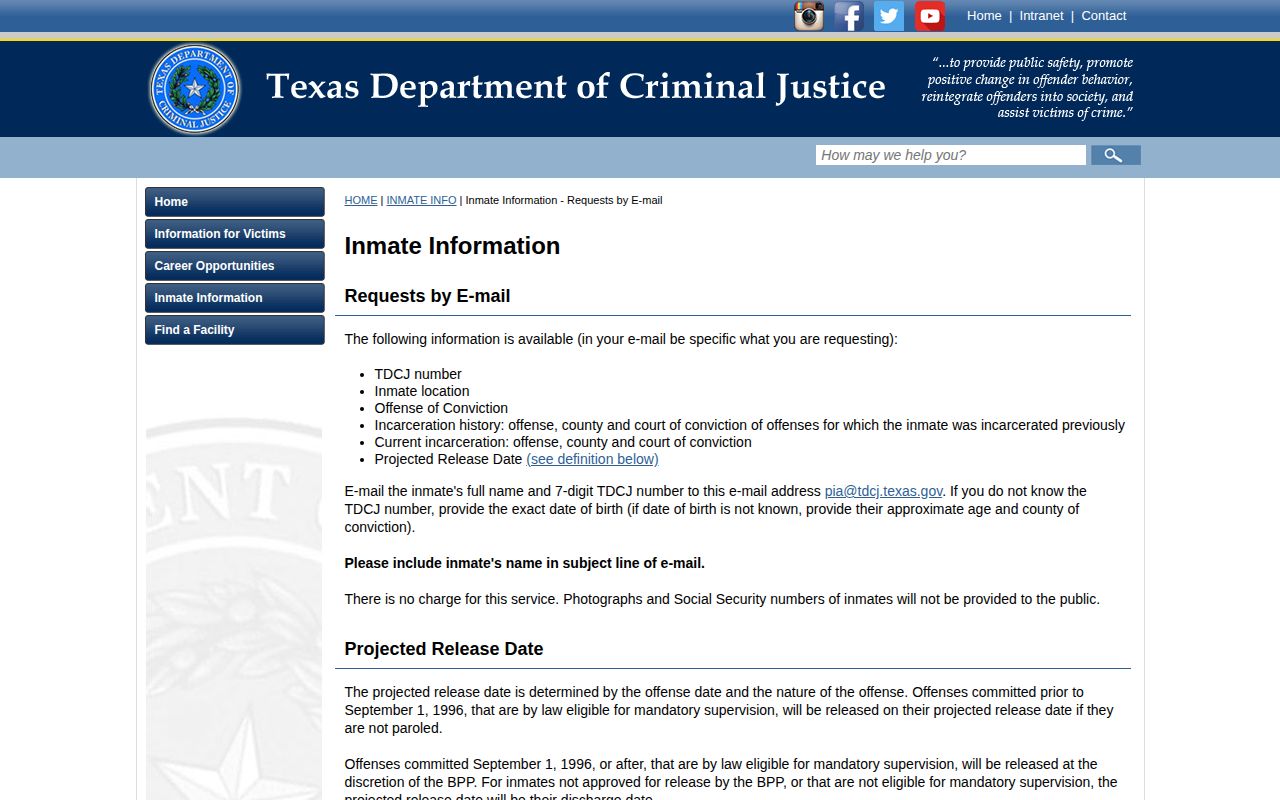
The source reinforces that the field belongs to current state custody and that an official request is needed when a former inmate no longer appears online.
Confirming a Falls County Actual Release
Near a scheduled state-prison release, call the unit before pickup because TDCJ may designate a different release unit. Reentry and Integration handles release-location and pickup questions at 936-437-5040 or rid@tdcj.texas.gov. When the scheduled type says parole or mandatory supervision, confirm the field-office route after release.
After a current TDCJ record disappears, email pia@tdcj.texas.gov with the full name and TDCJ number, or exact date of birth or approximate age and conviction county. Ask for prior incarceration and actual release or discharge information. The online search intentionally focuses on current inmates, so no result can also mean a former inmate, county-only detainee, or name mismatch.
For notification before the event, the Falls County VINELink release check explains the separate county and TDCJ alert systems. Retain any alert, but confirm the event with the custodian. A release notice may not disclose whether another agency took custody immediately.
- Detainer
- A request or legal hold that may cause continued custody or transfer.
- Mandatory supervision
- Conditional release governed by statutory eligibility and Board rules.
- Discharge
- End of the identified sentence rather than release under parole supervision.
- Transfer
- Movement to a new custodian while confinement continues.
Documenting a Falls County Date Lookup
Dynamic TDCJ results should be saved with the retrieval date and the identifier used. The unit, projected date, Board status, and scheduled release details can change at different stages, so an undated note is hard to reconcile with a later result.
When two results conflict, do not select the earlier or later date by preference. Compare the TDCJ or SID number, then ask the records office which current field controls. Keep the court judgment and any detainer or consecutive-sentence record with the search result. This small record trail helps distinguish a real recalculation from a same-name mistake.
After the event, replace the projection with the actual release, transfer, parole, mandatory-supervision, or discharge record. If no public former-inmate result remains, use TDCJ's email, telephone, or formal Public Information Act channel. Online disappearance is expected for former inmates and does not establish the date on which custody ended.
Public Record Search
Sponsored Results