
William P. Hobby Release Paths
William P. Hobby Unit, facility code HB, is part of the TDCJ Correctional Institutions Division. It holds sentenced women in G1 through G5 custody classifications. A person leaving Hobby may enter the community on parole or discretionary mandatory supervision, discharge at the end of the sentence, or move to a different state unit. Only the first three are potential community-release events. A unit transfer is continued TDCJ custody.
Parole is conditional release approved through the Texas Board of Pardons and Paroles before the maximum sentence date. Mandatory supervision is a statutory release structure based on calendar time plus eligible good time, subject to the governing law and Board review for eligible cases. Discharge generally means the sentence and related TDCJ supervision have ended. None should be inferred from a changed unit name.
| TDCJ event | Custody meaning | Record to check |
|---|---|---|
| Parole | Community release under conditions | Board result, scheduled release, Parole Division |
| Mandatory supervision | Conditional community release if authorized | TDCJ release type and supervision record |
| Discharge | Sentence endpoint without further TDCJ confinement | TDCJ incarceration and release history |
| Unit transfer | State custody continues | Current unit and movement history |
Confirm William P. Hobby Release
Begin with the TDCJ Online Inmate Search. It accepts a last and first name, TDCJ number, State Identification number, gender, and race. A current result may show the unit, projected release date, parole eligibility date, maximum sentence date, conviction details, and sentence information. Those dates serve different purposes. A projected date remains a calculation, and eligibility only marks when Board consideration may occur.
- Match the exact name and TDCJ or SID identifier.
- Confirm the current facility is Hobby Unit, code HB.
- Read projected, eligibility, maximum, and scheduled fields separately.
- Record the scheduled release type and location when TDCJ posts them.
- After departure, request TDCJ history and verify parole supervision when applicable.
A scheduled or projected date is prospective. The actual TDCJ release or discharge event requires a historical record or post-event confirmation.
Former prisoners may eventually disappear from the current-only online search. That absence is expected and is not an affirmative released status. Use TDCJ email, telephone, or Public Information Act routes for prior incarceration and actual release detail.
William P. Hobby Records Contact
The official Hobby Unit directory controls the facility's current identity and contact details. Unit staff can address facility-specific matters, but central TDCJ records and release offices hold the broader incarceration and scheduling trail.
William P. Hobby Unit (HB)
742 FM 712
Marlin, TX 76661
Phone: 254-883-5561
Published records hours: not stated in the research
For basic public offender information, TDCJ accepts email inquiries through its offender information channel. Give the full name and seven-digit TDCJ number. If the number is unknown, include an exact date of birth or approximate age and county of conviction. For release type, history, or another existing record, use the formal TDCJ public-information route rather than asking Hobby Unit to calculate a date.
William P. Hobby Unit Profile
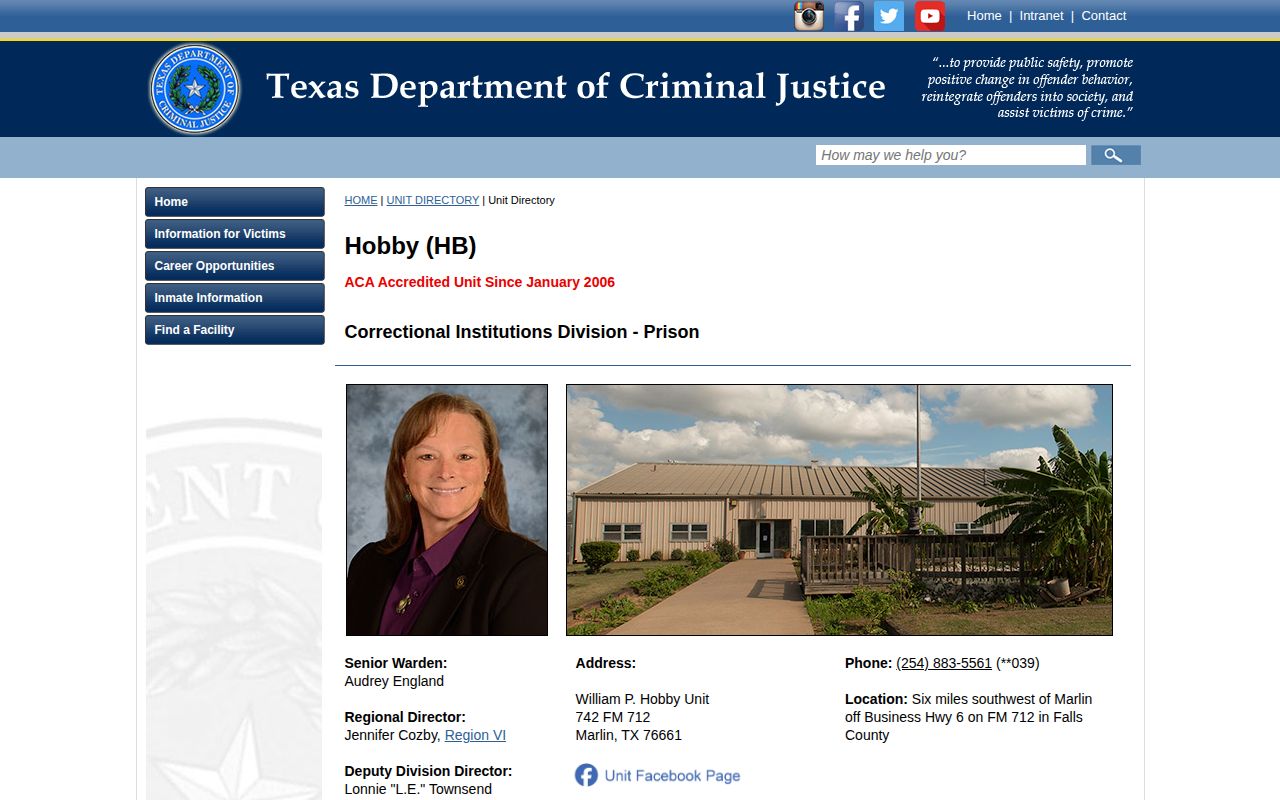
The official directory identifies Hobby as a TDCJ women's prison six miles southwest of Marlin, off Business Highway 6 on FM 712. Its listed capacity is 1,384, with G1 through G5 custody. Those classifications describe levels within the state prison system. They do not turn the facility into a county jail, and the Falls County Sheriff does not control its offender roster or release decision.
The source directory pictured below provides the appropriate facility reference. Consult the TDCJ Hobby Unit page for live directory details.
Hobby Release Dates Explained
TDCJ's projected release date is an internal estimate based on the information then available. The parole eligibility date means the person may be considered; it is not approval. The maximum sentence date reflects the sentence endpoint as calculated by the agency. Once processing advances, TDCJ may post a scheduled release date, type, and release location. Scheduling is stronger evidence, yet it can still change due to review, a detainer, a program prerequisite, or another sentence.
- Projected release
- A records and classification calculation, not a promise of release.
- Parole eligibility
- The point when Board consideration may be permitted.
- Scheduled release
- A planned date, type, and location after release processing reaches that stage.
- Discharge
- The end of the sentence or supervision obligation reflected by TDCJ records.
Texas good time cannot be reduced to a universal percentage formula. Offense date, offense type, classification, disciplinary loss, consecutive sentences, program work, statutes, Board action, and detainers can change the result. Read the official field and obtain the agency computation when a date is disputed.
Hobby Pre-Release Programs
Hobby's directory lists CHANGES/Pre-Release and Reentry Planning. These are genuine facility facts and can help explain preparation before an authorized departure. They are not public locators and do not show that a named person completed a program or received release approval. Program participation also should not be used to predict a gate date.
The TDCJ inmate-information hub shown below gathers the state search and related official routes. The TDCJ inmate information page is the right starting point when a current search needs an email or telephone fallback.
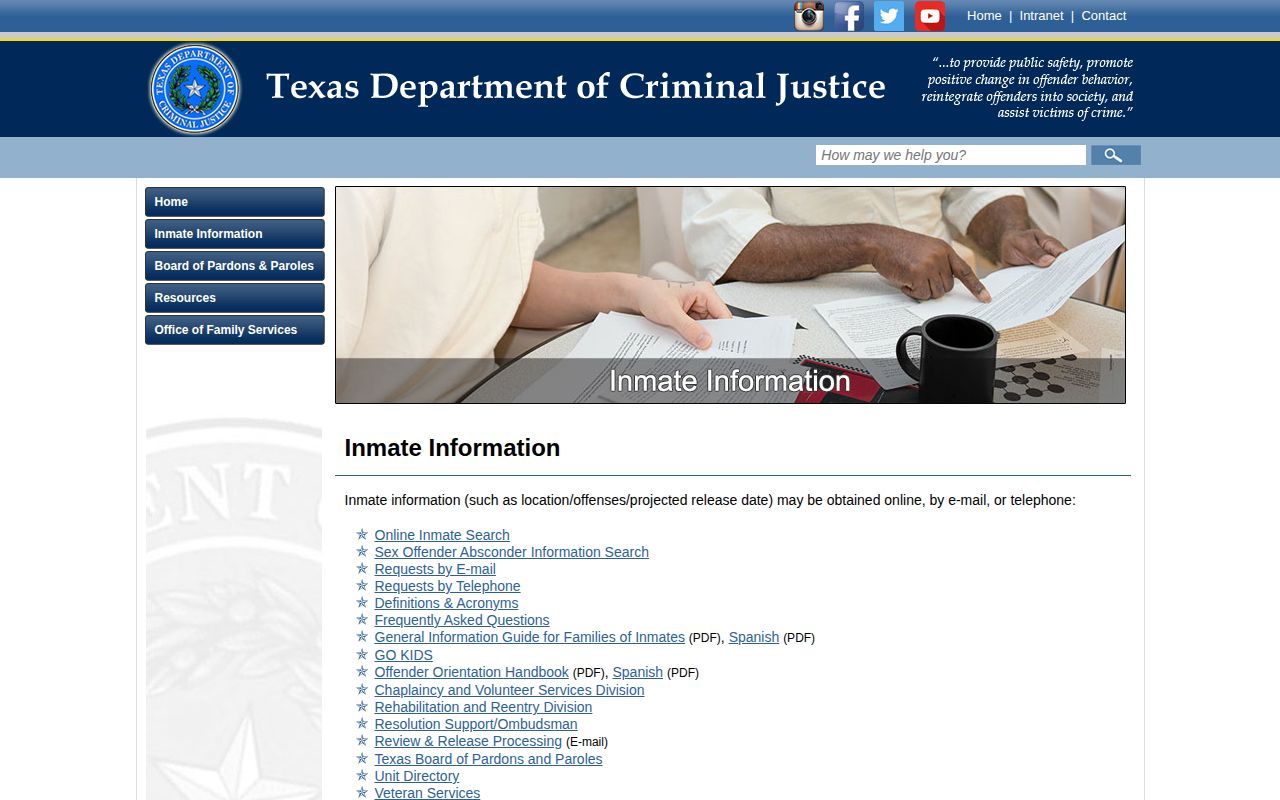
For same-day pickup questions, TDCJ directs people to release-processing information because the release unit may differ from the current housing unit. The Reentry and Integration Division can be reached at 936-437-5040 or rid@tdcj.texas.gov.
Hobby Transfers Across Falls County
Falls County also contains the sheriff-run Falls County Jail and TDCJ's Marlin Unit. A woman can vanish from the county roster after transfer to Hobby and remain confined. Likewise, she can leave Hobby for Marlin Unit or another TDCJ unit without any community release. Capture the operator, unit code, destination, and movement date to avoid merging records from nearby institutions.
This distinction also matters for notifications. Texas IVSS-Counties serves participating county custody and court events. TDCJ IVSS is the separate state-prison and parole notification channel. Enrollment in one should not be treated as enrollment in the other.
Hobby ICE Detainer Checks
A TDCJ release can be followed by another agency's custody. If the record specifically identifies ICE, the ICE detainee locator may show current detention and some recently released cases within its limited coverage. TDCJ departure to ICE is a transfer, not proof that the person entered the community.
An ICE locator miss proves little. Exact identifiers, processing delay, search limits, and the short released-person window can affect results. First obtain TDCJ's actual release type and destination. Then use the destination system. Federal or immigration searches should not be run merely because Hobby is a state prison; there should be a factual detainer or transfer link.
Verify Hobby Release Records
A complete Hobby release confirmation identifies the prisoner, unit, scheduled type, actual event, and any supervision or destination. Board approval alone is not the gate-exit time. A favorable decision can still require audit, treatment, transfer, scheduling, or resolution of a detainer. After physical departure, the TDCJ history and Parole Division route carry more weight than an old projected date.
If parole or mandatory supervision follows, Falls County maps to the Waco District Parole Office. That regional mapping does not prove any named person's status. Use it only after an official state record indicates supervision. For a broad comparison between local release and state discharge, consult the Falls County release-record hub.